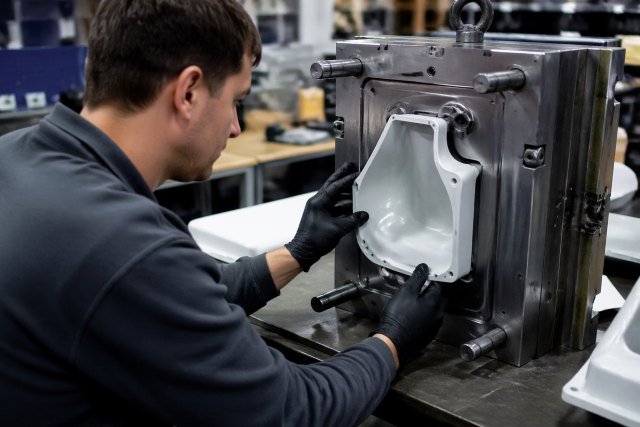
If you have come across the term Repmold recently, you are not alone. It has started appearing in online discussions about smart manufacturing, rapid prototyping, and digital production. The tricky part is that Repmold does not yet seem to have one universally accepted, formal industry definition. Across current web sources, it is most often described as a modern mold-making or mold-replication approach that blends digital design, automation, rapid prototyping, and, in some interpretations, 3D printing-assisted workflows. That makes it less like a single patented system everyone agrees on and more like a developing concept tied to faster, more flexible manufacturing.
That distinction matters. When a term is still emerging, good analysis depends on separating the stable manufacturing ideas behind it from the hype around it. In practical terms, Repmold is best understood as a production mindset: use digital tools to design molds faster, test them earlier, improve them with data, and reduce the delay between concept and production. That interpretation aligns with broader, well-established trends in manufacturing, including additive manufacturing, digital workflows, and rapid prototyping. NIST describes additive manufacturing as a digital process that builds products from digital designs and notes that it can reduce waste, while Autodesk explains that rapid prototyping helps teams test ideas earlier and iterate more quickly.
What Repmold Usually Means
In the most consistent usage found online, Repmold refers to a method or concept for creating molds and replicated parts with more speed and precision than traditional, fully manual workflows. Some sources describe it as a combination of digital modeling, automated replication, and modern material processes. Others frame it more specifically as a next-generation mold manufacturing approach that supports quick iterations, better accuracy, and scalable production. Even though the wording differs, the common theme is clear: Repmold sits at the intersection of mold-making, digital engineering, and production efficiency.
To understand why this matters, it helps to remember what a mold is in the first place. Britannica defines a mold as a cavity or matrix used to shape a fluid or plastic substance into a finished form, and explains that molds can be made from many materials depending on the application. In injection molding, material is heated, forced into a mold, cooled, and then removed as a finished part. Repmold appears to build on that traditional foundation by improving how molds are designed, tested, and reproduced before they enter full production.
Why Repmold Is Getting Attention
Manufacturing has changed. Companies no longer want long design cycles, repeated manual corrections, and expensive trial-and-error whenever a new product is introduced. They want faster product development, better repeatability, and lower waste. That is exactly why ideas like Repmold are attracting attention. Sources describing Repmold consistently emphasize faster prototyping, quicker production turnaround, improved accuracy, and less material waste compared with older, slower workflows.
This interest also fits a larger shift toward digital manufacturing. NIST notes that additive manufacturing depends on digital data across development lifecycles, and the organization’s research emphasizes measurement, standards, process monitoring, and reproducibility. Those same priorities show up again and again in descriptions of Repmold: digital design files, simulated testing, automated refinement, and better quality control. In other words, even if Repmold itself is still a loosely defined label, the reasons people are using the term are very real and very current.
How Repmold Works in a Practical Sense
A typical Repmold-style workflow starts with a digital design. Engineers or designers build a 3D model of the part or mold, then test that model before committing to expensive production tooling. Autodesk describes rapid prototyping as the fast fabrication of a physical part or model from CAD software, often through 3D printing, so teams can evaluate function and design earlier in development. That same idea appears central to Repmold: identify problems sooner, not later.
After digital modeling comes iteration. Instead of waiting until a mold is physically produced to discover flaws, a Repmold-oriented process tries to catch geometry issues, stress points, or flow problems at the design stage. Several sources say Repmold uses digital simulation or intelligent tools to optimize mold geometry and reduce inconsistencies. While those claims should be treated as descriptive rather than formally standardized, they match the direction of modern CAD/CAM and digitally managed manufacturing systems.
From there, the process may move into prototype mold creation or limited-run fabrication. In some interpretations, this involves additive manufacturing or hybrid techniques that allow faster tool development. NIST explains that additive manufacturing can produce complex designs with less waste, which helps explain why it is often linked to emerging mold-replication ideas. Repmold is not necessarily identical to 3D printing, but many descriptions of it assume that digital fabrication tools help shorten the path from design to usable mold components or test parts.
Repmold and Modern Manufacturing Strategy
One reason Repmold sounds appealing is that it matches what manufacturers already want from Industry 4.0: more connected data, more automation, better monitoring, and fewer costly surprises. Sources about Repmold often mention AI, predictive optimization, workflow automation, and data-driven decision-making. NIST likewise highlights the role of data, measurements, and process control in industrialized additive manufacturing. This suggests that Repmold is being marketed or discussed as part of the broader move from manual craftsmanship alone toward digitally supported manufacturing systems.
That does not mean traditional mold expertise becomes irrelevant. Quite the opposite. Mold manufacturing still depends on material behavior, cooling performance, dimensional accuracy, and production knowledge built over years of shop-floor experience. The real potential of Repmold is not replacing expertise but amplifying it. A skilled engineer using simulation, data, and faster prototyping can usually make better decisions than one forced to rely on slower feedback loops. That is where the concept becomes genuinely useful rather than just trendy language.
Industries Where Repmold Could Matter Most
Repmold is especially relevant anywhere speed, repeatability, and precision matter. Online sources repeatedly connect it with automotive, aerospace, consumer goods, and general product manufacturing. Those are logical fits because such industries often need complex shapes, strict tolerances, and a balance between prototype agility and production scale.
In automotive work, the value is easy to see. A company developing interior components, clips, housings, or specialty plastic parts can benefit from faster tooling cycles and better iteration before launch. In aerospace, even minor dimensional issues can create expensive delays, so any process that improves repeatability and catches design problems earlier has obvious appeal. In consumer goods, where product refresh cycles are shorter and market timing matters, a Repmold-style approach could help companies move from concept to shelf more quickly. These are reasonable applications because they reflect the core promise repeated across current descriptions of Repmold: quicker development without sacrificing precision.
The Real Benefits of Repmold
The first major benefit is speed. Repmold is repeatedly associated with reduced lead times in design, prototyping, and production preparation. Autodesk’s explanation of rapid prototyping supports the broader principle here: faster iteration helps teams test ideas early and make corrections before the cost of change rises.
The second benefit is accuracy. Multiple sources describe Repmold as improving precision, reducing design errors, and supporting more consistent outputs. While those claims come from descriptive web articles rather than formal standards documents, they align with the logic of digital design validation and process monitoring. When more of the mold-development cycle is modeled, tested, and refined in software, fewer issues should escape into later production stages.
The third benefit is flexibility. Traditional tooling changes can be expensive and slow. Repmold is often presented as a way to adapt designs faster, making it useful for custom products, short production runs, and markets where revisions happen often. That flexibility is increasingly valuable in an environment where customer expectations shift quickly and manufacturers must respond without rebuilding entire workflows from scratch.
The fourth benefit is sustainability potential. NIST notes that additive manufacturing can use less material and create less waste in some contexts, and several Repmold-related articles link the concept to waste reduction and more efficient use of resources. That does not guarantee every Repmold implementation is automatically greener, but it does suggest why the term is often associated with more efficient production models.
Limitations and Questions Around Repmold
For all its promise, Repmold also has a visibility problem: the term is still vague. There does not appear to be a single official standards body, major manufacturer, or universally recognized technical definition that clearly owns or governs the term today. Much of the current material comes from explanatory blog posts and trend-style articles rather than from deeply established industrial references. That means any serious decision-maker should focus less on the buzzword and more on the actual capabilities being offered: digital mold design, faster prototyping, simulation, automation, and production repeatability.
There is also the usual challenge of implementation. New digital workflows may require software investment, process changes, staff training, and better data discipline. Even powerful manufacturing methods fail when teams adopt the language without building the system behind it. Repmold can be valuable, but only when it is attached to real engineering practice, not marketing alone. This is an inference based on the requirements of digital manufacturing and automation systems rather than a direct claim from one single source.
The Future Potential of Repmold
The most interesting thing about Repmold is not whether the term becomes permanent. It is whether the approach behind it keeps spreading. All signs suggest that it will. Manufacturing is moving toward digital continuity, smarter prototyping, tighter quality control, and more connected design-to-production workflows. NIST’s ongoing work in additive manufacturing research, data standards, and process reproducibility points in the same direction.
So the future potential of Repmold is significant, especially if the term matures into a clearer framework for intelligent mold development. It could become shorthand for a manufacturing approach that combines CAD-based modeling, prototype acceleration, data feedback, simulation, and scalable mold production. Even if the label changes over time, the underlying industrial shift is already underway. Companies that understand that shift early are more likely to reduce delays, improve product quality, and stay competitive in markets where speed and precision now matter just as much as price.
Conclusion: Why Repmold Matters
Repmold matters because it captures a real change in how products may be designed, tested, and prepared for manufacturing. While the term itself still lacks a single formal definition, current usage points to a practical idea with real value: combine digital design, faster prototyping, smarter process control, and more efficient mold development to shorten the distance between concept and production. For engineers, manufacturers, and product teams, that is not a minor improvement. It is a meaningful shift in capability.
If you are evaluating Repmold for business or technical use, the smartest move is to look past the label and study the workflow. Ask whether it improves design iteration, tooling speed, precision, waste reduction, and scalability. If it does, then Repmold is more than a trendy term. It is a useful lens for understanding where modern manufacturing is headed.
FAQ: Common Questions About Repmold
Is Repmold a company or a manufacturing process?
Based on current search results, Repmold is more commonly described as a manufacturing concept or process rather than a clearly established single company or official standard.
Is Repmold the same as 3D printing?
No. Repmold is better understood as a broader mold-development or replication approach that may use digital modeling, automation, and sometimes 3D-printing-assisted prototyping, but it is not simply another word for additive manufacturing.
Why are people interested in Repmold?
The interest comes from the promise of faster prototyping, improved precision, quicker design changes, and lower waste in modern manufacturing workflows.
What is the biggest risk when reading about Repmold?
The biggest risk is assuming the term has a single precise definition when it does not yet appear to. It is safer to evaluate the actual manufacturing methods being described than to rely on the buzzword alone.