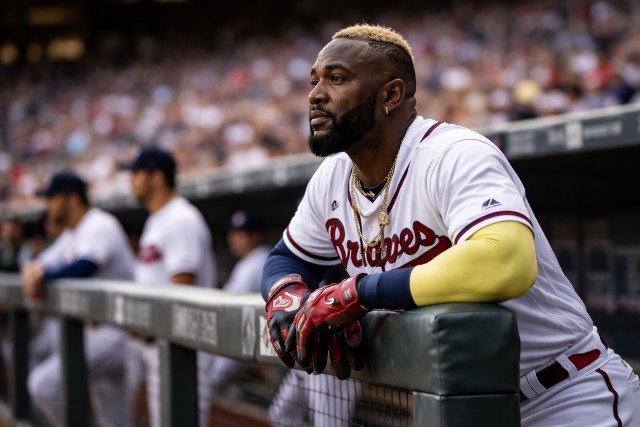
The phrase Braves Marcell Ozuna Waiver Candidate makes sense only if we place it in the right timeline. During the Braves’ difficult 2025 season, Ozuna’s name repeatedly surfaced in trade and roster-construction conversations as Atlanta tried to balance short-term competitiveness with longer-term planning. By late July and early August, the club had already reduced his role, and MLB.com reported that the front office was focused on players who could help in 2026 and beyond.
That matters because the topic is no longer just a rumor exercise. The Braves picked up Ozuna’s $16 million option heading into 2025, but after the season they did not bring him back, and he eventually signed a one-year deal with the Pittsburgh Pirates on February 16, 2026, with a mutual option for 2027. In other words, the “waiver candidate” debate was really part of a broader question: when should Atlanta move on from an aging designated hitter, and what would that decision mean for the rest of the roster?
That is what makes this story interesting from an SEO and baseball standpoint. It is not just about whether the Braves could have cut ties with a familiar slugger. It is about how clubs decide when production, payroll, age curve, roster flexibility, and clubhouse fit stop pointing in the same direction. In Ozuna’s case, Atlanta had to weigh his big 2024 output against a much shakier 2025 and then decide whether designated hitter at-bats were better used on younger or more flexible options.
Why the Braves Marcell Ozuna Waiver Candidate topic gained traction
A year earlier, this conversation would have sounded absurd. Ozuna was one of Atlanta’s most dangerous bats in 2024, playing all 162 games and producing a .302 average with 39 home runs and 104 RBIs. He even opened that season on a historic tear, ranking among the league leaders in home runs and RBIs in April. That level of production made him look like a middle-of-the-order fixture, not a player people would discuss in terms of waivers, trade salary dumps, or reduced playing time.
Baseball changes quickly, though, especially for hitters in their mid-30s who offer most of their value at designated hitter. In 2025, Atlanta still got counting-stat production from Ozuna, but the overall picture looked more ordinary. Baseball-Reference’s team page shows him with 21 home runs, 68 RBIs, and 1.6 WAR over 145 games for the 2025 Braves, a noticeable drop from his 2024 standard. That decline alone would not have made him expendable on a contender, but it did make the front office more willing to think about what came next.
The bigger turning point came when Atlanta started treating his role as fluid instead of fixed. MLB.com reported on August 1, 2025, that the Braves were taking Ozuna’s playing time “on a day-to-day basis.” That is the kind of language that usually tells you a team is not just managing a slump. It is reevaluating how the roster should function, especially if the player in question is not a strong defensive contributor and does not fit the team’s future core.
Just before that, MLB.com had also framed Ozuna as one of the players Atlanta could part with at the 2025 Trade Deadline. The reporting made the front office logic clear: if the Braves moved Ozuna or Raisel Iglesias before the deadline, they would simply be doing a few months early what might have happened anyway once the season ended. That did not automatically make Ozuna a literal waiver candidate in the formal transaction sense, but it absolutely put him in the category of players a team might move, reduce, or cut loose if roster priorities changed.
What Atlanta was really deciding
Whenever fans hear “waiver candidate,” they often think only in emotional terms. Is the player washed? Is the contract bad? Is the front office panicking? The reality is usually more practical than that.
For Atlanta, the real issue was how much value a DH-only or DH-heavy veteran still provided compared with other uses of the lineup card. If Ozuna was mashing, the answer was easy. If he was merely decent while younger or more versatile hitters were pushing for at-bats, then the calculation changed. That is why roster rumors around Ozuna had as much to do with opportunity cost as with Ozuna himself.
The Braves also had a natural internal pressure point: the catching group. In 2025, MLB.com openly raised the question of whether Atlanta’s productive catchers should steal some designated hitter time while Ozuna struggled. That reporting matters because it shows the club was already imagining the DH slot as something more flexible than “Ozuna every day.” Once a team begins using the position that way in public conversation, the path toward an offseason separation becomes much easier to see.
And that is exactly where the Braves ended up. By Opening Day 2026, Atlanta’s roster construction had shifted. MLB.com’s roster coverage said the club expected Garrett Cooper Smith to be the primary designated hitter against right-handed pitching, with role-sharing from other players, while Drake Baldwin would serve as the DH on many days he was not catching. That is a very different model from the old setup where Ozuna occupied the DH role as a near-daily fixture.
Braves Marcell Ozuna Waiver Candidate rumors versus what actually happened
It is worth separating rumor language from transaction reality. Ozuna was not simply dumped onto waivers in a headline-grabbing midseason move by Atlanta. Instead, the Braves signaled diminishing long-term commitment through lineup decisions, trade-deadline positioning, and eventual offseason separation. The end result was the same in roster terms: Atlanta moved on. But they got there through a staged process rather than a sudden release.
That distinction is important for readers trying to understand MLB roster management. Teams often test the market, reduce a role, and allow a contract to expire before taking harsher steps. Especially with veteran hitters who still carry some name value, clubs prefer a cleaner exit if possible. In Ozuna’s case, Atlanta appears to have reached the conclusion that its 2026 roster was better built around younger, more flexible bats rather than extending his stay. His February 2026 signing with Pittsburgh confirmed that the Braves were ready to turn the page.
The Pirates, for their part, saw enough upside to offer Ozuna a one-year deal reportedly worth $12 million with a 2027 mutual option and a $1.5 million buyout. That tells us the broader market still believed there was rebound potential, even if Atlanta no longer viewed him as part of its next roster cycle. Different teams can look at the same player and reach different conclusions because their timelines, payroll structures, and lineup needs are not the same.
Why Atlanta’s decision can look smart now
Early 2026 results have only intensified the belief that the Braves made the right call. MLB and ESPN stat pages show Ozuna struggling badly with Pittsburgh in the opening weeks of 2026, carrying a very low batting average and minimal production through mid-April. Small samples can mislead, and veterans can still rebound, but front offices are paid to anticipate decline before it becomes impossible to ignore. Atlanta seems to have done exactly that.
That does not erase what Ozuna meant to the Braves when he was rolling. He was a huge part of their offense in 2024 and still offered usable power in 2025. But roster building is not an award for past service. It is a constant attempt to allocate future plate appearances and future dollars in the smartest way possible. If the Braves believed the DH role could be redistributed more efficiently, then moving on was less about disrespect and more about timing.
The roster context supports that view. Atlanta’s 2026 depth chart and roster reporting suggest a club leaning into lineup flexibility, catcher/DH rotation, and matchup-based usage rather than locking one veteran into the role by default. That shift is subtle but meaningful. It opens plate appearances for younger contributors and creates more ways to optimize the lineup over a long season.
Possible roster changes the Ozuna debate pointed toward
The Ozuna conversation was never only about one player. It pointed toward several broader roster changes for Atlanta.
First, it hinted at a more shared designated hitter structure. Instead of one veteran taking most of the DH at-bats, the Braves could spread those opportunities across catchers and other bats needing partial rest. That kind of setup can improve lineup depth and keep players fresher over six months. MLB.com’s 2026 roster outlook strongly supports that interpretation.
Second, it reinforced the importance of defensive and positional flexibility. A player who contributes mostly with the bat has to hit enough to justify the limitation. Once that bat cools off, the roster squeeze becomes obvious. Atlanta’s willingness to imagine other players in the DH slot shows the organization was prioritizing versatility more than before.
Third, it signaled a subtle age transition. Contending teams do not rebuild in the dramatic way weaker clubs do, but they still phase out veterans whose future value no longer matches their roster cost. The Braves’ handling of Ozuna looked like that kind of transition: not chaotic, not sentimental, just deliberate.
What fans can learn from the Braves Marcell Ozuna Waiver Candidate story
This story is a good reminder that rumors often describe a trend before they describe a transaction. Fans heard “Ozuna could be moved,” “Ozuna could lose playing time,” and “Atlanta may be thinking about 2026.” Those were not empty talking points. They were clues about how the club valued the DH spot and how it wanted to reshape the roster.
It also shows how quickly perception can swing. In 2024, Ozuna looked indispensable. In 2025, he looked more expendable. By 2026, he was no longer on the Braves at all. That is not unusual in modern baseball. Aging curves, payroll pressure, prospect development, and lineup flexibility can move faster than fan sentiment.
For content publishers, this is also the key to writing useful sports analysis. Do not just chase the rumor phrase. Explain the mechanism behind it. In this case, the value is in showing that “waiver candidate” was shorthand for a deeper roster question: should Atlanta keep dedicating a premium offensive slot to Ozuna, or should it use that space to prepare for the future? The Braves answered that question by moving on, and so far the decision looks defensible.
Final takeaway
The Braves Marcell Ozuna Waiver Candidate conversation was less about a dramatic waiver-wire moment and more about the gradual end of a roster fit. Atlanta had every reason to ride Ozuna when he was producing like a star, especially in 2024. But by 2025, the signs were there: reduced playing time, trade chatter, questions about future lineup construction, and a growing interest in using the DH role more creatively.
Now that Ozuna is with Pittsburgh and Atlanta has redistributed those at-bats, the bigger picture is easier to see. The Braves were not just reacting to one slump. They were reshaping the roster around flexibility, age curve management, and 2026 priorities. That is why the Braves Marcell Ozuna Waiver Candidate topic still matters: it captures the moment when Atlanta’s front office started choosing tomorrow’s roster over yesterday’s production.