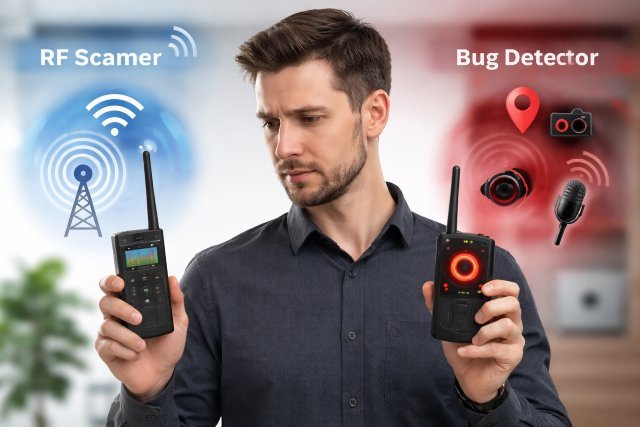
When it comes to protecting your privacy and detecting hidden surveillance devices, tools like an RF Scanner and a bug detector are often mentioned interchangeably. However, despite their similarities, these devices serve different purposes and operate in distinct ways.
In today’s world, where hidden cameras, listening devices, and wireless trackers are increasingly accessible, understanding the difference between these tools is essential. Whether you’re a business owner safeguarding sensitive data or a traveler concerned about privacy in unfamiliar environments, knowing which device to use can make all the difference.
What is an RF Scanner?
An RF Scanner (Radio Frequency Scanner) is a device designed to detect and analyze radio frequency signals in a specific range. These signals are emitted by wireless devices such as hidden cameras, microphones, GPS trackers, Wi-Fi devices, and Bluetooth gadgets.
An RF scanner works by scanning the electromagnetic spectrum for active transmissions. When it detects a signal, it alerts the user, often displaying signal strength or frequency details.
How RF Scanners Work
RF scanners continuously sweep through frequency bands, typically ranging from a few MHz to several GHz. When a signal is detected within that range, the scanner identifies its presence and may provide additional data such as frequency type or signal intensity.
These devices are commonly used in:
-
Counter-surveillance operations
-
Technical debugging of wireless systems
-
Security inspections in offices or hotels
According to the Federal Communications Commission (FCC), radio frequency signals are used in almost all wireless communication devices, making RF scanners a powerful tool for detecting active transmissions.
What is a Bug Detector?
A bug detector, also known as a spy bug detector or anti-spy device, is specifically designed to locate hidden surveillance devices such as:
-
Hidden cameras
-
Audio listening devices
-
GPS trackers
Unlike a general RF scanner, a bug detector is typically optimized for identifying covert surveillance threats. Many modern bug detectors combine multiple technologies, including RF detection, infrared scanning, and magnetic field detection.
How Bug Detectors Work
Bug detectors often use a combination of detection methods:
RF detection to identify wireless transmissions
Infrared scanning to detect camera lenses
Magnetic sensors to locate wired or battery-powered devices
This multi-layered approach makes bug detectors more specialized for privacy protection rather than general signal analysis.
RF Scanner vs Bug Detector: Key Differences
Understanding the difference between an RF Scanner and a bug detector comes down to their purpose, functionality, and level of specialization.
Purpose and Use Case
An RF scanner is a general-purpose device used to detect and analyze radio frequency signals across a wide spectrum. It is commonly used by professionals such as engineers, security experts, and technicians.
A bug detector, on the other hand, is specifically designed for identifying hidden surveillance devices. It is more user-friendly and tailored for personal privacy protection.
Detection Capabilities
RF scanners detect all types of RF signals, including those from harmless devices like Wi-Fi routers and smartphones. This means users must interpret the results to distinguish between normal and suspicious signals.
Bug detectors are more refined in this regard. They are designed to focus on suspicious signals and often include additional detection methods like infrared scanning for hidden cameras.
Ease of Use
RF scanners can be complex and may require technical knowledge to interpret signal data. They are better suited for professionals or users with some understanding of radio frequencies.
Bug detectors are generally plug-and-play devices. They are designed for everyday users and often include visual or audio alerts to indicate potential threats.
Accuracy and Precision
RF scanners provide detailed information about signals, making them highly accurate for technical analysis. However, they may produce false positives if the user cannot differentiate between signal sources.
Bug detectors aim to reduce false positives by focusing on common surveillance device signatures. This makes them more practical for non-technical users.
When Should You Use an RF Scanner?
An RF Scanner is ideal in situations where you need a broad understanding of the wireless environment.
For example, in corporate environments where sensitive data is handled, security teams may use RF scanners to monitor unusual signal activity. If an unauthorized device begins transmitting data, the scanner can detect it.
Similarly, RF scanners are useful for:
Troubleshooting wireless networks
Detecting signal interference
Monitoring frequency usage in secure areas
In these scenarios, the ability to analyze detailed signal data is more important than ease of use.
When Should You Use a Bug Detector?
Bug detectors are best suited for individuals who want to quickly and effectively identify hidden surveillance devices without needing technical expertise.
For instance, travelers staying in hotels or Airbnb accommodations often use bug detectors to check for hidden cameras. With privacy concerns on the rise, this has become increasingly common.
According to a survey by SafeHome.org, over 11% of travelers reported finding hidden cameras in rental properties, highlighting the importance of such tools. (Source: https://www.safehome.org)
Bug detectors are also useful for:
Personal privacy checks at home
Office meeting room inspections
Vehicle tracking detection
Their simplicity and targeted functionality make them accessible to everyone.
Can an RF Scanner Replace a Bug Detector?
This is a common question, and the answer is not entirely straightforward.
An RF scanner can detect signals from hidden devices, but it lacks the specialized features of a bug detector. For example, it cannot easily identify camera lenses or detect non-transmitting devices.
On the other hand, a bug detector often includes RF scanning capabilities but enhances them with additional detection technologies.
In practice, professionals often use both tools together. An RF scanner provides a broad overview of signal activity, while a bug detector helps pinpoint specific threats.
Advantages of Using an RF Scanner
One of the biggest advantages of an RF scanner is its versatility. It can detect a wide range of signals, making it useful for multiple applications beyond surveillance detection.
It also provides detailed insights into frequency activity, which can be valuable for technical analysis and troubleshooting.
Another key benefit is its ability to detect continuous and intermittent transmissions, which is crucial for identifying sophisticated spying devices.
Advantages of Using a Bug Detector
Bug detectors excel in ease of use and specialization. They are designed to quickly identify potential threats without requiring technical knowledge.
Their multi-functional capabilities, such as infrared scanning and magnetic detection, allow them to detect both wireless and wired devices.
This makes them highly effective for everyday users who want reliable privacy protection.
Real-World Scenario: RF Scanner vs Bug Detector
Imagine you are staying in a hotel room and suspect that your privacy may be compromised.
Using an RF scanner, you detect multiple signals in the room. However, distinguishing between harmless devices like Wi-Fi routers and potential threats can be challenging.
Now, using a bug detector, you scan the room and receive a focused alert near a smoke detector. Upon closer inspection, you discover a hidden camera.
This scenario highlights how a bug detector simplifies the detection process, while an RF scanner provides broader but less targeted information.
Common Misconceptions
One common misconception is that RF scanners and bug detectors are the same device. While they share some overlapping functionality, their primary purposes differ significantly.
Another misconception is that RF scanners can detect all types of surveillance devices. In reality, devices that are not actively transmitting signals may go undetected.
Similarly, some users believe bug detectors are foolproof. While effective, they are not 100% accurate and should be used alongside visual inspections.
How to Choose Between an RF Scanner and a Bug Detector
Choosing the right device depends on your specific needs.
If you require detailed signal analysis and have technical expertise, an RF scanner is the better choice.
If your goal is quick and easy detection of hidden surveillance devices, a bug detector is more suitable.
In many cases, combining both tools offers the highest level of security.
Future Trends in Surveillance Detection
As surveillance technology becomes more advanced, detection tools are also evolving.
Modern devices now incorporate AI-based detection, improved signal filtering, and enhanced sensitivity. According to research from MarketsandMarkets, the global surveillance technology market is expected to grow significantly, increasing the demand for advanced detection tools. (Source: https://www.marketsandmarkets.com)
This means both RF scanners and bug detectors will continue to improve in accuracy and usability.
Frequently Asked Questions
What is the main difference between an RF Scanner and a bug detector?
An RF Scanner detects all radio frequency signals, while a bug detector is specifically designed to find hidden surveillance devices using multiple detection methods.
Can an RF Scanner detect hidden cameras?
Yes, an RF Scanner can detect hidden cameras if they are transmitting signals. However, it may not detect cameras that are not actively transmitting.
Are bug detectors accurate?
Bug detectors are generally accurate for identifying common surveillance devices, but they are not perfect and may occasionally produce false positives.
Which device is better for personal use?
For most individuals, a bug detector is better due to its ease of use and targeted functionality.
Conclusion
Understanding the difference between an RF Scanner and a bug detector is crucial for anyone concerned about privacy and security. While both devices play an important role in detecting surveillance threats, they are designed for different purposes.
An RF Scanner offers broad signal detection and detailed analysis, making it ideal for professionals and technical use cases. In contrast, a bug detector provides a user-friendly, targeted approach to identifying hidden cameras and listening devices.
Ultimately, the best choice depends on your needs. For comprehensive protection, combining both tools can provide the most effective solution.
As technology continues to evolve, staying informed and equipped with the right tools is essential to maintaining your privacy in an increasingly connected world.