


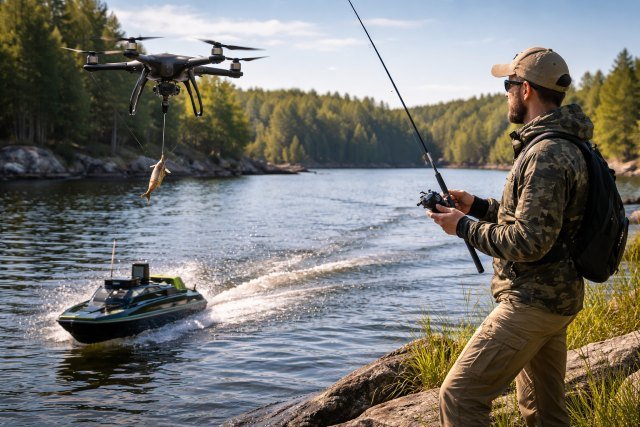
The rise of modern technology has completely transformed the fishing experience, and one of the most exciting innovations is the Fishing Drone. Anglers are no longer limited to casting from shore or relying on traditional boats. Today, tools like fishing drones and RC boats allow you to place bait precisely where fish are most active.
But this leads to an important question: which is better for fishing — a Fishing Drone or an RC boat? Both tools offer unique advantages, and choosing the right one depends on your fishing style, budget, and environment.
In this in-depth guide, we’ll explore the differences, advantages, and real-world applications of both options so you can make an informed decision.
What Is a Fishing Drone?
A Fishing Drone is a specialized aerial drone designed to carry fishing bait and release it at a targeted location. Unlike regular drones, these devices are built with waterproof components, payload release systems, and extended flight ranges.
Fishing drones are especially popular for surf fishing, offshore casting, and reaching areas that are otherwise inaccessible. Some advanced models even come equipped with GPS tracking, fish-finding cameras, and auto-return features.
According to research from the FAA (Federal Aviation Administration), drones are increasingly being used for recreational and commercial purposes, including fishing applications, due to their precision and efficiency.
What Is an RC Boat for Fishing?
An RC fishing boat is a remote-controlled watercraft used to carry bait across the water. These boats are commonly used in carp fishing and lake fishing, where anglers need to place bait quietly and accurately.
RC boats typically feature bait hoppers, GPS navigation, and long battery life. Unlike drones, they travel on the water’s surface, making them more stable in windy conditions.
Many anglers prefer RC boats for calm waters because they are easier to control and generally more affordable than fishing drones.
Fishing Drone vs RC Boat: Key Differences
Range and Accessibility
When it comes to range, the Fishing Drone has a clear advantage. Most fishing drones can travel several hundred meters to even a few kilometers, depending on the model. This allows anglers to reach deep waters where larger fish are often found.
RC boats, on the other hand, are limited by water conditions and signal range. While some high-end models offer extended range, they typically cannot match the distance capabilities of drones.
This makes fishing drones ideal for surf fishing and ocean environments, while RC boats are better suited for lakes and ponds.
Ease of Use
RC boats are generally easier to operate, especially for beginners. Since they move on water, controlling them feels more intuitive, similar to steering a toy boat.
Fishing drones require more skill. Piloting a drone involves managing altitude, wind conditions, and battery life. Beginners may need time to get comfortable using them.
However, modern drones are becoming more user-friendly with features like GPS stabilization and auto-hover.
Cost Comparison
Cost is a major factor when deciding between a Fishing Drone and an RC boat.
Fishing drones are typically more expensive due to advanced technology, cameras, and payload systems. Entry-level models may start around $500, while premium options can exceed $2,000.
RC boats are more budget-friendly, with many reliable options available between $100 and $600. This makes them a popular choice for hobbyists and beginners.
Precision and Bait Placement
Both tools excel in precision, but they achieve it differently.
Fishing drones allow you to drop bait from above, giving you a clear aerial view of the water. This is especially useful for spotting fish activity or avoiding obstacles.
RC boats rely on water navigation, which can be affected by currents, weeds, and debris. However, in calm conditions, they can deliver bait with impressive accuracy.
Durability and Risk
RC boats are generally more durable because they are designed to operate in water. Even if they flip, many models can recover or float safely.
Fishing drones, however, carry a higher risk. If a drone crashes into water, it may be permanently damaged unless it is specifically waterproof.
This makes RC boats a safer option for anglers who want to minimize risk.
Advantages of Using a Fishing Drone
The Fishing Drone offers unmatched versatility and innovation. One of its biggest strengths is the ability to access remote fishing spots without physically traveling there.
Drones also provide a bird’s-eye view, which can significantly improve your chances of locating fish. This is particularly useful in saltwater fishing, where fish schools can be spotted from above.
Another major advantage is speed. A fishing drone can quickly deliver bait to a distant location, saving time and effort compared to traditional casting methods.
Advantages of Using an RC Boat
RC boats shine in simplicity and reliability. They are easy to operate, making them ideal for beginners or casual anglers.
They also perform exceptionally well in calm waters, where precision bait placement is crucial. Carp anglers, for example, often rely on RC boats to place bait in exact locations repeatedly.
Additionally, RC boats are quieter than drones, which can help avoid spooking fish in certain environments.
Real-World Use Cases
Imagine you’re fishing on a beach with strong waves. Casting your line far enough to reach deeper waters can be challenging. In this scenario, a Fishing Drone becomes invaluable, allowing you to drop bait hundreds of meters offshore with ease.
Now consider a calm lake surrounded by vegetation. An RC boat would be more effective here, as it can navigate quietly through the water and place bait precisely where fish are feeding.
These examples highlight how each tool excels in different environments.
Environmental Considerations
Environmental factors play a crucial role in choosing between a Fishing Drone and an RC boat.
Wind can significantly affect drone performance, making it difficult to maintain stability. Water currents, on the other hand, can impact RC boats, especially in rivers or rough seas.
According to NOAA (National Oceanic and Atmospheric Administration), wind and water conditions are key factors influencing fishing success and equipment performance.
Understanding your fishing environment will help you choose the right tool.
Maintenance and Longevity
Fishing drones require regular maintenance, including battery care, motor checks, and firmware updates. Since they are electronic devices, repairs can be costly.
RC boats are simpler to maintain. Basic cleaning and occasional battery replacement are usually sufficient to keep them running smoothly.
This makes RC boats a more practical choice for anglers who prefer low-maintenance equipment.
Which One Should You Choose?
The decision ultimately depends on your fishing needs and preferences.
If you’re looking for advanced features, long-range capability, and the ability to explore new fishing spots, a Fishing Drone is the better choice.
If you prefer affordability, ease of use, and reliability in calm waters, an RC boat is the way to go.
Both tools have their place in modern fishing, and many experienced anglers even use both depending on the situation.
FAQ: Fishing Drone vs RC Boat
Is a Fishing Drone worth the investment?
Yes, a Fishing Drone is worth it if you frequently fish in large bodies of water or need extended range. It can significantly improve your fishing efficiency and success rate.
Are RC boats good for beginners?
RC boats are excellent for beginners because they are easy to operate and require minimal technical knowledge.
Can a Fishing Drone catch fish directly?
No, a Fishing Drone does not catch fish directly. It is used to carry and drop bait, allowing you to fish more effectively.
Which is safer to use?
RC boats are generally safer because they operate on water and are less likely to be damaged compared to drones.
Conclusion
When comparing a Fishing Drone and an RC boat, there is no one-size-fits-all answer. Each tool offers unique benefits tailored to different fishing environments and styles.
A Fishing Drone stands out for its range, innovation, and ability to reach otherwise inaccessible areas. Meanwhile, an RC boat excels in simplicity, affordability, and reliability.
Ultimately, the best choice depends on how and where you fish. By understanding the strengths and limitations of each option, you can elevate your fishing experience and increase your chances of success.

